Pearl
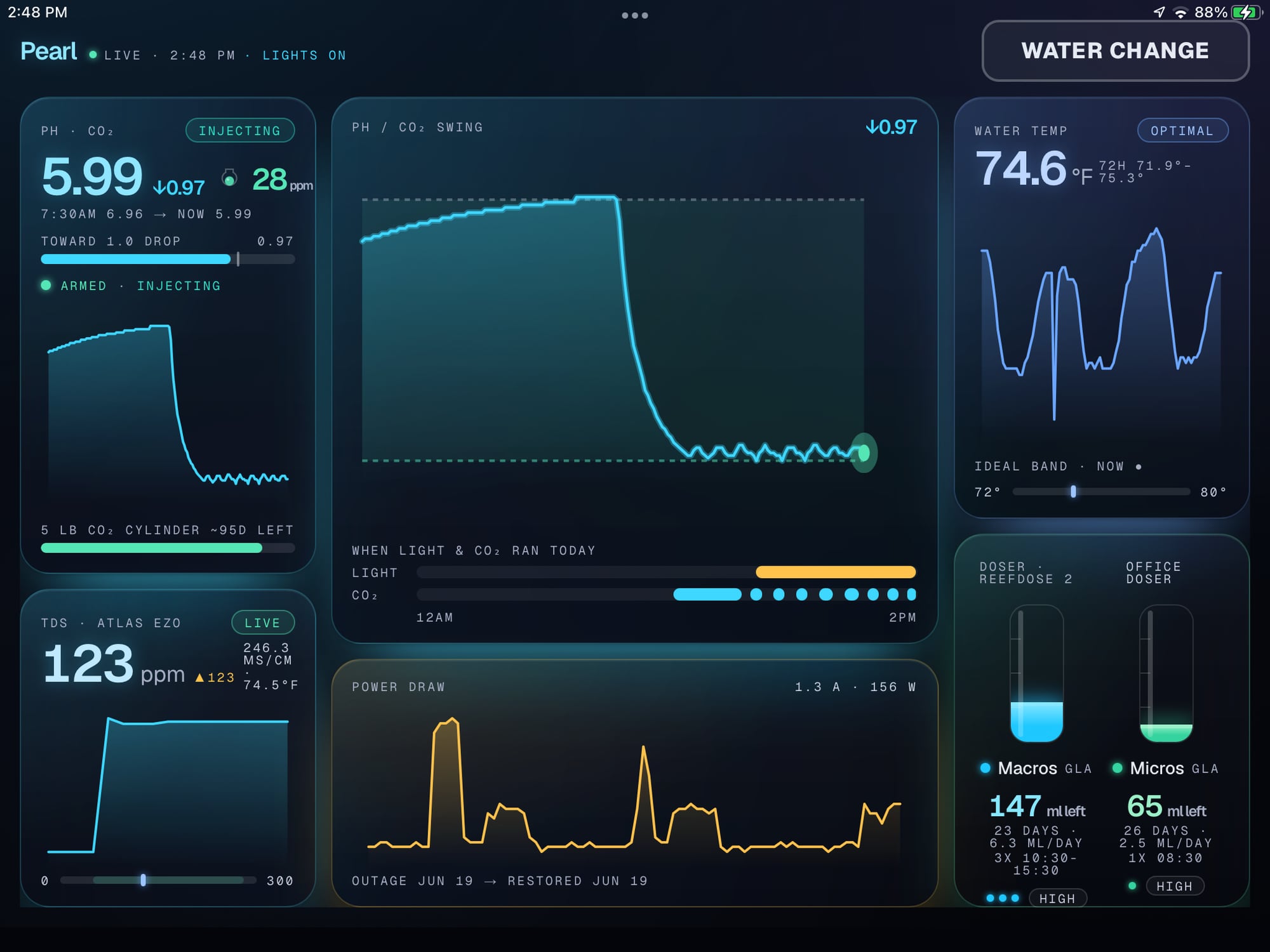
Pearl is the software behind this aquarium. It reads the Apex controller, the probes and the doser, keeps the record the rest of this site is drawn from, and can switch things on and off through the Apex when there is a reason to.
Overview
Pearl runs on a Raspberry Pi next to the tank. It polls the Apex every few minutes, reads the Red Sea doser over its own local API, writes both to a database, and serves two things off that database: a private set of tools for running the aquarium, and the public pages here.
It exists because the earlier scapes left nothing behind. Maintenance decisions survived as impressions and a few photographs, and there was no way to tell from those whether anything was improving. Logging came first. Control came later, and only in places where logging had already shown it was worth doing.
Recorded Data
These are counted from the database when the page loads. If the logger stalls, the date below goes stale and you can see that it has.
- Continuously logged
- Temperature, pH, conductivity, outlet states and alarm state
- Recorded by hand
- Water tests (37 logged, last on September 7, 2026) and PAR readings at each plant position
- First reading
- June 14, 2026
- Most recent reading
- September 24, 2026
Events logged
- /Filter flow profile switched: 155, last on September 22, 2026
- /Water change: 37, last on September 23, 2026
- /Fertilizer dose: 17, last on June 26, 2026
- /Note: 6, last on September 19, 2026
- /pH probe calibration: 4, last on September 20, 2026
- /pH probe replacement: 3, last on September 20, 2026
- /trim: 1, last on September 18, 2026
- /plant: 1, last on September 18, 2026
These are counts of what was logged, which is not the same as what was done. Fertilizer in particular is still going in by hand and does not get an entry every time, so treat that line as a floor rather than a tally.
Control Architecture
Pearl can turn things on and off, but not directly. It writes what it wants to a flag, the Pi picks that up on its next poll and sets a virtual outlet on the Apex, and the Apex decides what that means for the physical relay. The water-change routine works this way, and so did CO₂ when the loop was closed. Vercel cannot reach a controller sitting on a home network, so the Pi is the bridge in both directions.
The practical effect is that the Apex is still the thing in charge. A pH floor, the permitted CO₂ window and the leak sensor are configured on the controller, so they hold whether or not Pearl is running, and a bad deploy cannot widen them. Pearl asks. The Apex is what actually decides.
Beyond that it schedules the CO₂ window, tracks how long it has been since the last water change and filter service, flags readings that sit outside their usual band, and drives a wall display so the tank can be read at a glance.
Doser Telemetry
The Red Sea ReefDose is a separate device with its own API, so Pearl reads it directly rather than through the Apex. Both heads are picked up individually: what each one doses, the schedule it runs, the milliliters it has put in today against what it was supposed to, how much is left in the container, when the head was last calibrated, and whether the device thinks it needs recalibrating.
- Head 1
- GLA macros, 6.3 ml/day, three doses between 10:30 and 15:30
- Head 2
- GLA micros, 2.5 ml/day, one dose at 08:30
- Currently
- Configured and calibrated, containers empty, auto-dosing off
The schedule above is what the doser is set up to run, not what it is currently running. The containers are empty and auto-dosing is off, so fertilizer is still going in by hand. That is the weakest part of the setup. Hand dosing varies, and while it varies there is no clean way to say whether a change in the tank came from light or from nutrition. Filling the containers and switching it on is the fix, and everything needed to measure whether it worked is already reporting.
Operational Limits
- /It does not hold the safety limits. The pH floor, the CO₂ window and the leak sensor are configured on the Apex, so they survive Pearl being offline or wrong.
- /It does not touch physical outlets. Everything it switches goes through an Apex virtual outlet, and the controller applies its own rules on top.
- /It is not currently holding the pH loop closed. It can, and it did. A fixed window is steadier on water with no carbonate buffer.
- /It does not drive the doser. It reads it. The ReefDose runs its own schedule, when there is anything in the containers to run.
- /It does not publish anything that would signal whether anyone is home. Outlet detail and host addresses stay on the private side.
System Architecture
- Runs on
- A Raspberry Pi beside the aquarium, on the local network
- Reads
- A Neptune Apex controller and its probes, and a Red Sea ReefDose over its own API
- Application
- Next.js on Vercel, with a Postgres record behind it
- Displays
- A private dashboard, a wall display, and this public site
- Switches
- Apex virtual outlets, relayed by the Pi, applied by the controller
Every system by the job it does · What the record says right now